
RFID tags
- RFID tags
- Features
- Industry Applications
- Warehousing and logistics
- Animal management
- Healthcare
- Library & Archive Management
- Laundry Management
- Tobacco management
- Item Management
- Jewelry Management
- Power management
- Beauty and Personal Care Management
- Aviation Management
- Asset management
- Event Timing
- Vehicle identification
- Footwear and apparel management
- Food control
- Printing Equipment
- Specialty Tags
- Reader/writer devices
I. Overview of RFID Tags
In recent years, as people's understanding of RFID technology has continued to deepen and application costs have continued to decrease, RFID technology has rapidly become widespread across various industries.
In the apparel industry, major footwear and apparel manufacturers such as Uniqlo, Decathlon and H&M have already applied RFID technology on a large scale to improve supply chain efficiency. Libraries of all sizes across the country have also chosen RFID solutions to manage massive book collections, and various products such as librarian workstations, self-service return machines, mobile inventory carts and sorting machines have emerged. Airlines use RFID technology to track baggage in real time, greatly reducing the rate of lost passenger luggage.
RFID electronic tags can be divided by frequency into low-frequency RFID tags, high-frequency RFID tags, and ultra-high-frequency RFID tags, among which ultra-high-frequency RFID tags are the most widely used, mainly due to the following advantages:
(1) UHF RFID tags have a longer reading distance;
(2) Strong security and confidentiality;
(3) Can identify objects moving at high speed;
(4) can identify multiple objects simultaneously;
(5) Reusable and with large data storage capacity.
II. Types of RFID Tags
Different industries and application scenarios have different requirements for tag performance and form. This mainly depends on the balance of factors such as business needs, process conditions, cost, and application environment.
XGSunRFID tags developed and produced:
By Function, and can be classified into anti-metal tags, anti-liquid tags, ARC-certified standard tags, tamper-evident fragile tags, transferable tags, ECO eco-friendly tags, LED locating tags, single-chip dual-frequency tags, open-circuit detection tags, and more.
By Application Scenario, covering retail management, footwear and apparel management, warehousing and logistics management, asset management, jewelry management, medical management, animal management, laundry management, event timing management, aviation management, library and archive management, etc., which can be described as applications across all industries. The most common is the footwear and apparel industry, which is also one of the fields with the largest consumption of UHF RFID tags. The application of RFID technology in the footwear and apparel industry is a complete process covering every link from factory to warehouse to retail terminal. It can automatically collect data at each operational step, such as incoming material inspection, inbound and outbound, transfers, location moves, and inventory counting, thereby ensuring the speed and accuracy of data input at every stage of warehouse management and enabling enterprises to timely and accurately grasp the true inventory data and reasonably maintain and control their inventory.
By formDivide, common types include standard RFID adhesive labels, coated paper hang tags, textile labels/woven labels, flexible anti-metal labels, PCB labels, ABS labels, PPS labels, ceramic electronic tags, silicone labels for garment washing/linen tags, cable tie tags, epoxy resin PVC card labels, etc.
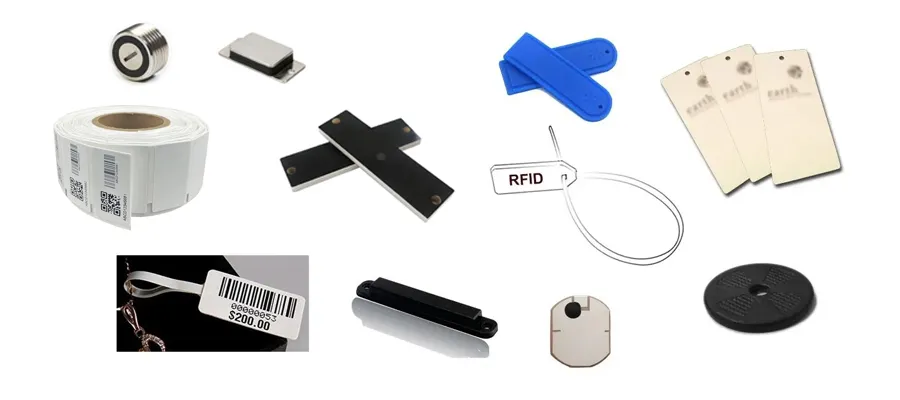
XGSun, with 17 years of deep cultivation in the RFID field and relentless technical refinement and innovative breakthroughs. Among them, the XGSun RFID Label Division has independently developed and produced a series of RFID label products favored by domestic and international customers. These products cover ARC-certified standard labels, tamper-evident fragile labels, transferable labels, ECO eco-friendly labels, single-chip dual-frequency labels, open-circuit detection labels, foam labels, and specialty labels, each embodying our persistent pursuit of quality and innovation. We can provide you with high-quality, cost-effective RFID labels and customize them according to your specific needs. If needed, please contact us as soon as possible.